Tom Stock

Poet, Essayist, Photographer, Naturalist

One Monarch Butterfly

Two zinnia beds in the front yard attracted a monarch butterfly. I was watering when it landed on a big red flower. I turned off the hose and watched. It probed the circle of tiny yellow flowers in the center. I opened its wings, closed them then jumped off flutter- gliding to another flower – always the red ones. It landed on many red flowers always jumping into the air and browsing.

`        It flew off to the neighbor’s front yard, then back to the zinnias. It stayed in the area for a half hour. I could see its two bulbous antennae touching, always touching. Then it flew off again. I waited. This happened five or six times. It was trying to find more flowers but always returned to the two zinnias beds. It nervously probed with its proboscis several times for each flower. It looked to me as if this animal was `desperate for food. Sometimes it kept this long tubular tongue in one flower probably finding more nectar. All the time, it’s silent wing motions contrasted with a siren of a passing EMS truck, a landscaping crew, and a couple of teenagers shouting.

I ran into the house to fetch my camera. The monarch was gone. I recall seeing hundreds of monarch holding onto a shrub on Fire Island. During migration, they stop flying as darkness descends.  Those days are gone.  Where will my monarch go?

At the Edgewood Preserve, a New York State Department of Conversation in Deer Park, I came upon a huge stand of milkweed plants…hundreds of them. They are a small island refuel oasis for monarchs. I hope they find these plants.

I started orange milkweed plants from seed. I planted two dozen seedlings (also called butterfly weed) in a center island of wildflowers in hopes of attracting monarchs. However, there are hardly any monarchs any more.

I had the opportunity to observe one for a half hour. It is easily the most beautiful living thing in the neighborhood. The color and patterns on its wings, the way it flies, how it jumps off a flower, and its choice of flower. There was plenty for me to see right outside in the front yard. I grow zinnias every year mostly to have cut flowers of us and friends. But with the visit by a single monarch, I have the best bouquet ever, a single butterfly found an oasis.

“We have met the enemy and it is us.”

Planet Earth has only one enemy. These beings have broken the carrying capacity barrier. They have over run the place by their sheer numbers. Overpopulation is the term. Too many, too dam many of US.

It is each and every one of us. No one and everyone is to blame. We are at war and we don’t even know it. It is far worse than nuclear war, or any other kind of war. No other species is doing battle and winning. We are war mongers and we keep on, day by day, week by week, month by month, year by year, century by century, all the way back to when we became homo sapiens. We only think we are “sapiens” we have lost our minds.   

My Breast Plate

Even since I saw the movie “Dances with Wolves,” I wanted a breast plate vest. Indians in the movie, presented Kevin Koster with a breast plate as a symbol of trust and friendship. They knew he was on their side as military troops ambushed that killed them at the frontier moved westward.

I’ve seen many pictures of Indians wearing breast plates in books and movies. They are cultural icons of form and function. The bone pieces come from buffalo. The bones were rasped into tubes slightly tapered at each end. They were hollow and strung together to form a protection against arrows like today’s bullet proof vests.

It was a sign of bravery, protection and pride. I saw one in the Peabody Museum of Natural History in New Haven, Connecticut.

Fall Planting: Spinach

I planted spinach seeds today during a hot, humid day early August day. We’ll start harvesting in late September cool weather increases.

The instructions say, each seed inch apart and inch deep. In the past, In the past, I have sprinkled the seeds using index finger and thumb. This doesn’t not guarantee following the instructions as seeds dribble out of hand onto soil in uneven patterns. I have a manic nature. This time I intended to override this behavior and plant slowly and carefully.

The Mourning Dove

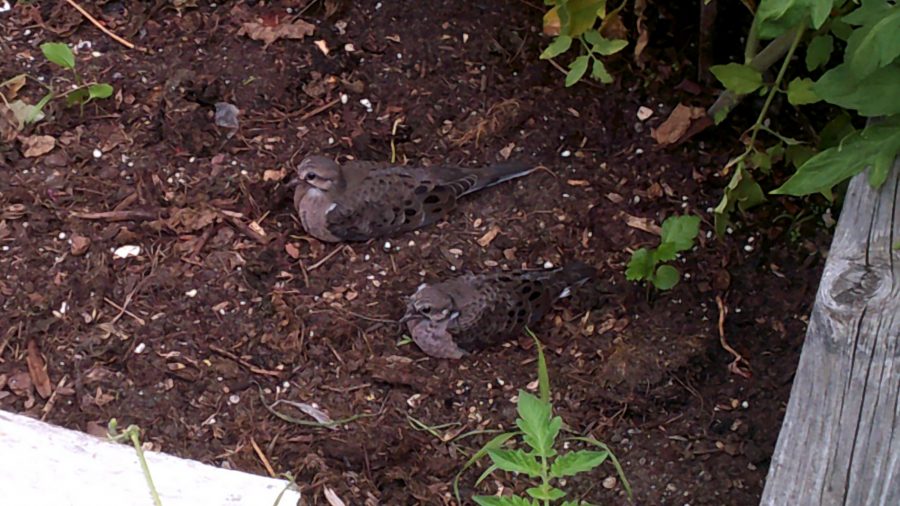
I hear sad, moaning calls from an overhead wire It is daybreak when I usually fetch the morning papers. The sounds seem to come from a hollow voice box. I see a pair silhouetted as the Sun’s tip just cuts above a distant bank of trees. Their back and forth calls come out of quiet dawn.

My daughters called them “Oh Oh birds.” Mourning Doves mourn. It is a sad call. Who are they mourning? Could it be their relative the Passenger Pigeon hunted to extinction? Could it be air pollution, water pollution, pesticides and herbicides? And maybe even all the thousands of chemicals that my cause cancer? I mourn with them.

Glint

Conditions have to be perfect
For the eye to catch a speck of light
A reflection so perfect,
The angles just so
For sunlight to bounce through a pupil

A car windshield, three miles away
Crossing the Captree Causeway Bridge
Catches a ray, transmits it to my eye
A silver shard of sun
That instantly dissolves

Accessing My First People Genes

1500 years ago, our Native American brothers had a vastly superior technology than ours today. They communicated by smoke signals with no phone bills. They traded, bartered, made wampum, no savings bank, no ponzi schemes, and no retirement. Don’t call their technology primitive. They had no landfills, no pollution, didn’t bottom out their source of nutrition. They didn’t have to go to a lumber yard to buy materials to build a shelter. No traffic jams, no air pollution, no junk yards, no assisted living. Their hobby was survival. Herbs became medicine and on and on.


The earliest people learned the old fashioned way…no internet, yes trial and error, yes to passing on their skills and knowledge to the next generation. This doesn’t sound like savage living to me. They observed their environment without having to look at a screen. They learned the physical properties of plants and animals and learned how to use them.

They found stones that could be chipped into arrow points. They found bushes that had straight stems and used them to make arrows. They found hickory trees and found them flexible enough to bend to make the skeleton for a wigwam and bows. Deer skin became clothing. They found tobacco, burned it, and as it rose, gave thanks for nature. They were not materialistic. If they wiped out a species, they’d have to move. They learned how to fish, build canoes, and weave baskets from vines.


Fast forward to today I had a recent experience that might parallel their process. I happened to accidentally break off a branch of a bald cypress tree. This is a rare tree here in Babylon but found in abundance in the bayous of Louisiana. I wanted to inspect the needles. I noticed that the bark split where the break occurred. I tried peeling off the bark. It came off easily and in long pieces.  The bark didn’t break. With more experimentation, I scraped off the outer bark. What was left was a tough, flexible inner bark. I tied one in a knot. I’d accessed my Native brothers skills. I’d found a plant that could help me tie a wigwam structure. No lumber yard necessary.

In The Herb Garden

Lots happening in mid-July

Perfect timing for insects and herbs

It’s as if they were waiting for this moment

Heat, growth, water, all converge

Who is attracting whom?

Cabbage butterflies congregate in lavender

One thinks food, the other continuity

This frenzy at midday

Essential oil aerosols and manic wasps

On bee balm flower heads

Flies, bees, beetles

It’s a carnival, a feast

A homecoming medicine cabinet

Jane Ann’s Cake

HER DIVINE CAKE,

WALNUTS AND CRANBERRY

MOIST AND TASTY

SITS ON A TABLE

¾ GONE, KNIFE NEARBY

OTHERS KNOW AS WELL AS I

JANE ANN HAS BAKED A LOAF

BROUGHT IT TO HOMECOMING FARM


OH THE JOY OF TAKING A BREAK

FROM WEEDING OR HARVESTING

TO SIT A WHILE, SWIG SOME WATER

AND…

ENJOY A SLICE OF JANE ANN’S CAKE


OCTOBER 30, 2015

POET IN RESIDENCE, TOM STOCK

Three Hundred Sixty

Smack in the center

Of fifty growing beds

I make a slow clockwise turn

Looking and listening.


The remnants of last seasons’ leeks and kale

An open landscape with sky and trees

A water tower where ravens hang

A tall brick building on the west

Small aircraft drone overhead

Granite gravestones just beyond the compost pile

A double line of Norway maples

Beyond that, the Dominican cemetery

The hoop house, tool shed, garlic building

The port a potty, the processing station

The utility shed and distribution tent


What is all this without the people?

Farmer Don, Director Elizabeth

The interns, work/ share holders

In a collaborative symphony

Of grace, friendship, and cooperation

All part of a great turning

Of a world integrated

Alive, relevant, and intelligent

And most of all, one person

A Dominican nun

Who invites us to come home

And we have.

Page 7 of 30

Powered by WordPress & Theme by Anders Norén