I walked around the edge of the parking at Manorville Hills County Parking lot to pick up litter while awaiting Mark’s arrival. I found a Deptford Pink plant near the kiosk. This flower is a tiny pinnacle on the very top of a tall grass-like stem. Unless you are curious with good powers of observation and always looking for a new discovery, you’d probably miss this plant. I didn’t. The tiny pink, five petal flower is a shock because it is so small. It blabs its minute spot of color. I always look closer. The petals are pointed. Although it is a non native, I readily accept it as a native. It comes from the British Isles named after the town of Deptford, north of London.

The NYS DEC sent us five saplings as part of their wildlife habitat improvement program. We got crab apple, wild black cherry, vibernum, witch hazel, and a white spruce tree. I planted them and forgot about them. Two years later, we transplanted the crab apple, and the white spruce.
The white spruce ( poor little tree) ended up in the far corner of the driveway, near giant Hosta plants. Two years later, I decided to see how the tree was doing. I spread Hosta leaves and found my poor little tree.
It was alive. I must have stepped on it when I was pruning nearby. The trunk was slanted. The tree had needles and was healthy, but I felt guilty that I had provided it with a better place. I promptly top dressed with compost; propped it up, and watered. I cut away Hosta leaves. Since it was early summer, we decided to leave the tree in place and transplant it in the fall. I found a spot near the front gate. We intend to clear a 12 foot circle of lawn and develop it into a native wildflower garden with our poor little tree the centerpiece.
I promised myself “This will be your last move. You will flourish. Sidewalk passersby will admire your beauty. We will not decorate you at Christmastime. You are already decorated. You have two huge neighbors, a cypress and redwood will look over you and eventually you will reach your mature height. You will remind us of the mountainsides upstate where you prefer to grow.
So, poor little tree, before long, you will not be poor and you will not be little. You will create shade, bird perches and maybe a nesting place; you will provide oxygen to the atmosphere and take carbon dioxide from the air. We apologize and will not call you “poor little tree” any longer. You are a WHITE SPRUCE tree.

David smith is turning in his grave. The house he lived in back in the late 1700’s has been demolished. I stopped by to witness the event. A huge excavator and its operator raised the scoop and jaws to take bites out of a wall. I was listening to demolition. The shovel pushed down the portico and two pillars rolled to the ground. The shovel bashed through walls, clawed at the roof, while three hands held hoses to wet down dust. I listened to wood being crushed with crackling sounds and loud metallic bangs and squeals of the bucket and its jaw. The crowd heard the beeps as the machine backed up, the clank of the two huge iron treadmill wheels. Two huge dumpsters stood by waiting for the splinters of almost 250 year old house.
The house heard cows, chickens, and other livestock on the 200 acre farm of David Smith. The house that was history is no more. In its footprint, another 21’st century house awaits. While I took pictures, the foreman of the demo company commented to me.”I get all kinds of comments when we demo a house like this. You can’t save a house that is uninhabitable.” He gave me a cold bottle of water and he continued to supervise.

“We are picking antioxidants.” Nancy says as we walk toward a row of currant bushes. I noticed the stalks were loaded with blue-black fruit yesterday when I passed by during our regular work/pickup day. Don loaned us buckets. Nancy has wanted to make currant jam for two years. She’s made beach plum, crab apple, grape, and mint. This was her chance to try a new fruit. Nancy has donated jars of fruit in past years to Homecoming Farm’s harvest menu.
“You can’t grow blueberries on Long Island,” Don noted when he came by for a visit to see our progress. The soil isn’t right; the shrubs didn’t thrive, so he ordered 25 organic currant shrubs from California. Don likes to experiment with new crops. This experiment was a resounding success.
Wiley Creek is hard to find. It lies in a trough about 20 feet deep, is surrounded by thick vegetation, with private homes backing up to it. I wanted to walk the creek to compare it to “my creek” in Babylon and to have fun exploring and discovering.
Japanese knotweed blocked my view while walking along Wiley Creek. Russel Joy Park is a Fredonia Village recreation area. This park boarders the creek. There are basketball and tennis courts, a ball field, a picnic gazebo, and restrooms. My recreation was of a different sort. I wanted to find a place to descend into the creek and walk its bed as far as possible.
I found a place, barged through Japanese Knotweed and finally reached the creek. Creeks and me go way back. As a boy, I played along Cayuga Creek in Depew, upstate New York. I explored the Nissequogue River in Smithtown, in Suffolk County Long Island and wrote a book about it. Recently, I researched Sampawams Creek, created a Power Point program, and have extensive notes. I am fascinated by creeks.
All our vegetable scraps go into a bucket near the kitchen. When it’s full, I dump it on the compost pile. This compost is called green stuff. Brown stuff is dirt or horse manure. It piles up all year. I turn the pile in early spring, and again in late June. By then, things are heating up in the pile.
Roger, a neighbor, contributes green stuff in the form of cooked grass. He dumps a bucket on a tarp and I wheelbarrow it to the pile. “I’ll have plenty more cooked stuff when I get around to turning it”. He dumps grass clippings with no herbicides or pesticides. In the past, he’s gives me bags of sawdust from his shop. That helps too.
Not much decomposition takes place until the beginning of summer. Our wet May has kept the pile moist. Turning the pile added air. My second turning revealed plenty of worms. Worms indicate that decomposition is under way. Three factors for good breakdown are fungi, bacteria, and green/brown stuff. I set up a screen, the wheelbarrow, a shovel, and rake to sift. I consider sifting compost to be a special event and I look forward to it in early summer. My tomato plants and other vegetables will be top dressed with the sifted compost. I like to eliminate the branches and other stuff that doesn’t pass through the screen.
I shovel three shovels onto the screen and use the flat side of a rake to sift. For me, this is a meditation. It’s like making your own soil. The result is smooth textured, nutrient-rich soil. A handful of compost feels light and soft. The dirt gets under my fingernails. I consider this a blessing. The nutrients come from banana peels, cantaloupe, celery bottoms, apple sores, orange peels, egg shells, over ripe lettuce, and on and on.
The major elements are all in there…carbon, hydrogen, oxygen, nitrogen, potassium, iodine, zinc, sulfur, and phosphorus. There are trace elements as well… boron, magnesium, calcium, sodium, and chlorine. My plants love my sifted soil. I will top dress tomatoes, chard, onions, beans, lettuce, cucumbers, herbs, and zinnias. Their roots await the bouquet. I am part of a process that takes place world-wide, the cycle of growth and decay.
When I slice the first Cherokee purple tomato and see seeds and pulp and taste a real ripe tomato, my taste buds are dancing. I will not have to buy tomatoes for months. I can almost taste the compost. The worms’ hotel is my compost pile.
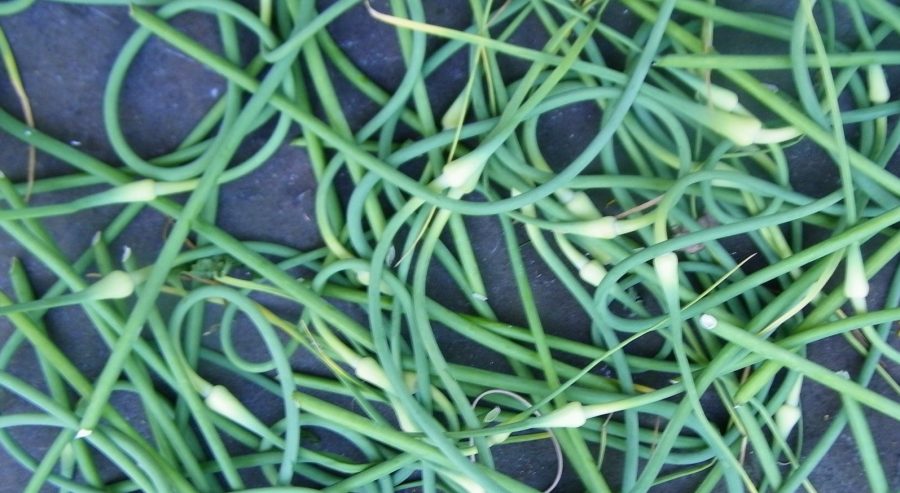
On our first work/share day at Homecoming Farm, Don, the farmer, asked me to cut garlic scapes. He showed me how to avoid the woody part which is at the bottom. “I make pesto from the soft part of the scape.” He said. I’ve sautéed scapes but included the woody part and found them not very palatable.
I carried a bucket to the garlic patch, a huge area with some 20,000 garlic bulbs. This was the perfect job for me because, not only do I love anything to do with garlic, but I’d have a chance to see the Ravens.
I battled some big weeds that grew in the path. I felt the stems and could tell where the woody part ended. I could tell by the force of the scissors as well. The scapes are the “flowers” of hard neck garlic plants. Hard neck means that the stalk is stiff. Soft neck garlic have no scapes and can be braded because they don’t have the woody tissue. They appear in late may and by late June, need to be cut. Leaving the scape on the plant causes less energy to seep into the bulb. All garlic growers know this. They want the biggest bulbs possible.
The top of the scape looks like a pointed turban. The scape curls. The top of the scape, if left to mature produces bulbils. Bulbils are tiny cloves. If these are planted, they will grow into tiny garlic plants. It will take 3-4 years for a decent sized garlic bulb to come from a bulbil. Hence, cutting the scape off the plant eliminates the bulbils. New garlic plants come from healthy cloves set in the ground in Late November.
As I cut, I hear and saw ravens. There are four roosting in the Norway maple trees north of the garlic beds. I heard them, saw them fly, circling, being chased by crows, and landing on the ground. Crows just don’t like other black birds and chase them just to get them out of their “territory.” I imitated raven calls and attracted two who flew over my head, checked me out, and bailed out back to the maples. They are intelligent birds.
Near the end of the row of 200 garlic plants, my back felt sore. There are four garlic plants side by side in a 200 foot row and there are ten rows. I covered a half a row. Finally, by bucket full, I escaped the scapes and headed for the pick up tent to get our share.
Most of us think food chains and food webs as ecology. Deep Ecology goes beyond that. It includes us. We are part of food chains and webs. Everything impacts other-than-human life as well as all forms of life. It’s awareness. We are in the Earth, as well as on the Earth. We see ourselves as part of all the biological and physical cycles on the Planet.
A walk on a beach thinking about where you are as well as who we are transforms our relationship with the Universe. We are in the presence of the horizon, water, sky, clouds, footprints, dune, beach, and sand. We are capable of knowing where all this came from. As we watch gulls, feel a cool breeze and keep in mind all of us are subjects related, relevant, and intelligent. W are part of the sun, our shadow, shells, and seaweed, all relatives. This is Deep Ecology. It is seeing ourselves as a part not apart.
Recently, I stopped to admire flower clusters on and elderberry bush. Tiny 1/8 inch flower, with five white petals, five anthers, and one pistol. Each cluster has about a hundred of these tiny flowers. Each will become a purplish-black fruit, used for jelly, wine, and pies. I remained still and saw tiny native bees flying fast and in angular patterns, landing, and pollinating. Many species of birds will descend upon these fruits and gobble them. Catbirds, robins, and a dozen other birds. Elderberry is part of the flow of energy known as a food chain. First people used elderberry stems to make blow pipes to invigorate their fires. Come fall, the eaves return to the ground and decompose, nourishing the bush for the following season.
Deep ecology is going deep to admire, be in awe, and connected to the whole of nature. Species has it’s own, unique biological and physical connection. Deep Ecologists try to design their living with the natural world in mind. They are aware of the consequences of the impacts humans have on the rest of nature and themselves.
To know something is to love it. To love it is to protect it. To protect it is to be involved in the web of all life on Planet Earth
I discovered something interesting on my walk around Argyle Lake. There on the water surface, a black hole surrounded by counterclockwise swirls. I stopped, hypnotized and curious.
At this point, water drains from the Lake into an auxiliary pond which is two feet lower than the lake. I checked the pond and saw a ribbed plastic pipe with water emptying. The conditions for these phenomena must have been perfect. The water level of the lake was just right. There was a faint hollow sound coming from the hole. My curiosity led me to the dictionary:
“A mass of spinning air, liquid, etc. that pulls things into its center”
I remember the Titanic as it slipped beneath the sea creating huge vortexes. To be caught in a vortex, you might be sucked in and drown.

If she’s scared
A good scream may help
Don’t hold back
Let it out
Press with the diaphragm
And force with as much power
As you can manage
A good scream can
Scare the crap out of
Whatever you’re afraid of
A blood-curdling high alert
For a mouse, axe murderer,
Spider in the shower stall
Husband says “I got goose bumps
And hair standing straight up
On the back of my neck.
You’ve scared the shit out of me.”
“It’s a defense mechanism” she says
“Honey, if it were an intruder
In the house, then scream your lungs out
Don’t cry wolf over a tiny spider.”